Shenzhen’s delivery riders now rush AEDs to cardiac victims
-
2026年7月15日
- Posted by: uesz
No Comments
In Shenzhen, the next delivery arriving at a doorstep might not be bubble tea or dim sum — it might be a second chance at life.
The city has launched a groundbreaking “AED Express Delivery” project, transforming its army of delivery riders into a high-speed network of lifesavers. By marrying instant-delivery logistics with lifesaving technology, Shenzhen is bringing automated external defibrillators (AEDs) to cardiac-arrest patients at courier speed.
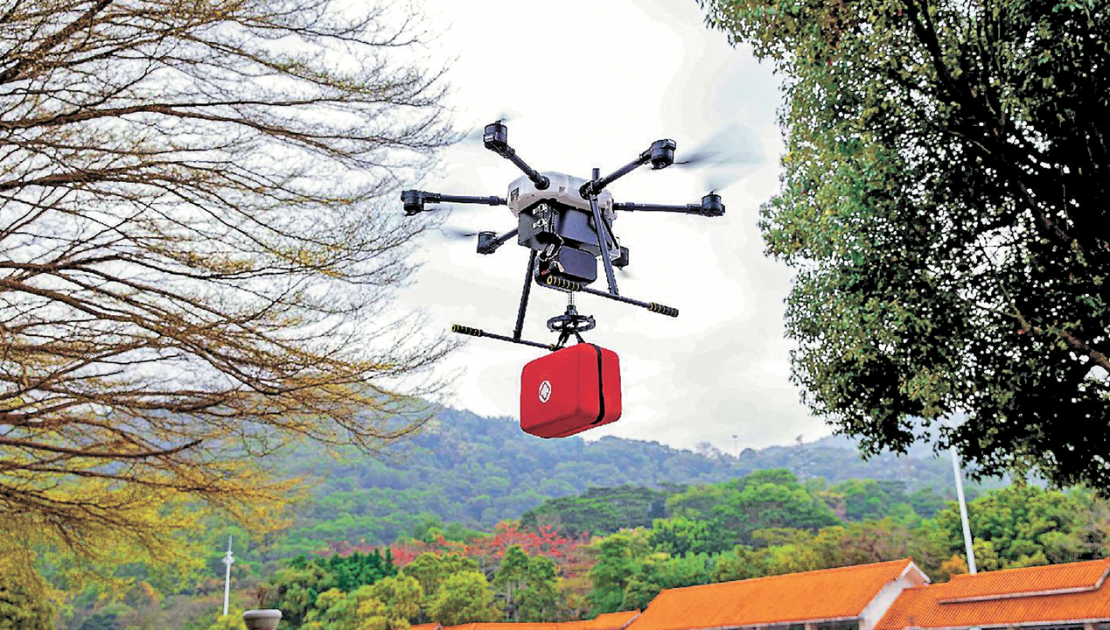
A drone air‑drops an AED at a Shenzhen country park. File photo
Under the new framework — forged by food delivery giant Meituan and tech titan Tencent — the moment a 120 dispatcher rules out a timely ambulance arrival due to traffic or distance, Tencent’s intelligent platform takes over. Within seconds, it triangulates the nearest available rider and the closest AED unit, computes the optimal retrieval route, and pushes a “rescue order” to the courier’s app. As the rider races to the scene, the 120 center keeps the caller informed in real time. Once the AED arrives, a remote emergency physician connects via video to guide the bystander — or the trained courier — through the resuscitation steps.
Meituan said at Friday’s launch ceremony that it plans to train 2,000 riders in first aid and AED operation this year, with 500 expected to earn official certification through rigorous assessments.
An in-vehicle display shows a cardiac emergency dispatch alert inside a Didi ride-hailing vehicle. Shenzhen has integrated Didi vehicles equipped with AEDs into the city’s emergency response system. Shenzhen Special Zone Daily
The delivery network, however, is only one layer of Shenzhen’s expanding digital safety net.
Ride-hailing platform Didi on Thursday announced that its Shenzhen fleet of vehicles equipped with in-car AEDs is now fully integrated into the municipal 120 framework. When a cardiac emergency is flagged, the platform scans for nearby Didi cars, sends an alert to the driver’s app, and dispatches the vehicle to intercept — effectively turning roving cars into mobile emergency assets.
An AED unite is installed inside Shenzhen Bao’an International Airport. Shenzhen has deployed more than 44,000 AED units across public venues as part of its effort to build a citywide emergency response network. File photo
Backing these mobile fleets is a staggering fixed infrastructure. Shenzhen now boasts more than 44,000 AED units, which were deployed across the airport, Metro stations, universities, gymnasiums, and convention centers.
The Metro system serves as the backbone of this safety net. All 432 stations across 17 lines are equipped with 1,350 defibrillators, supported by over 10,000 certified first-aid staff. Since 2019, the subway network has contributed to 72 documented saves.
Above ground, Shenzhen Bus Group has outfitted more than 600 buses and taxis with AEDs, backed by 15,000 trained employees. Residents in distress can simply flag down any vehicle displaying the AED logo — a simple act that bridges the gap between fixed-position devices in buildings and the unpredictable nature of street-side emergencies.